Coming soon
Every track, ready to play.
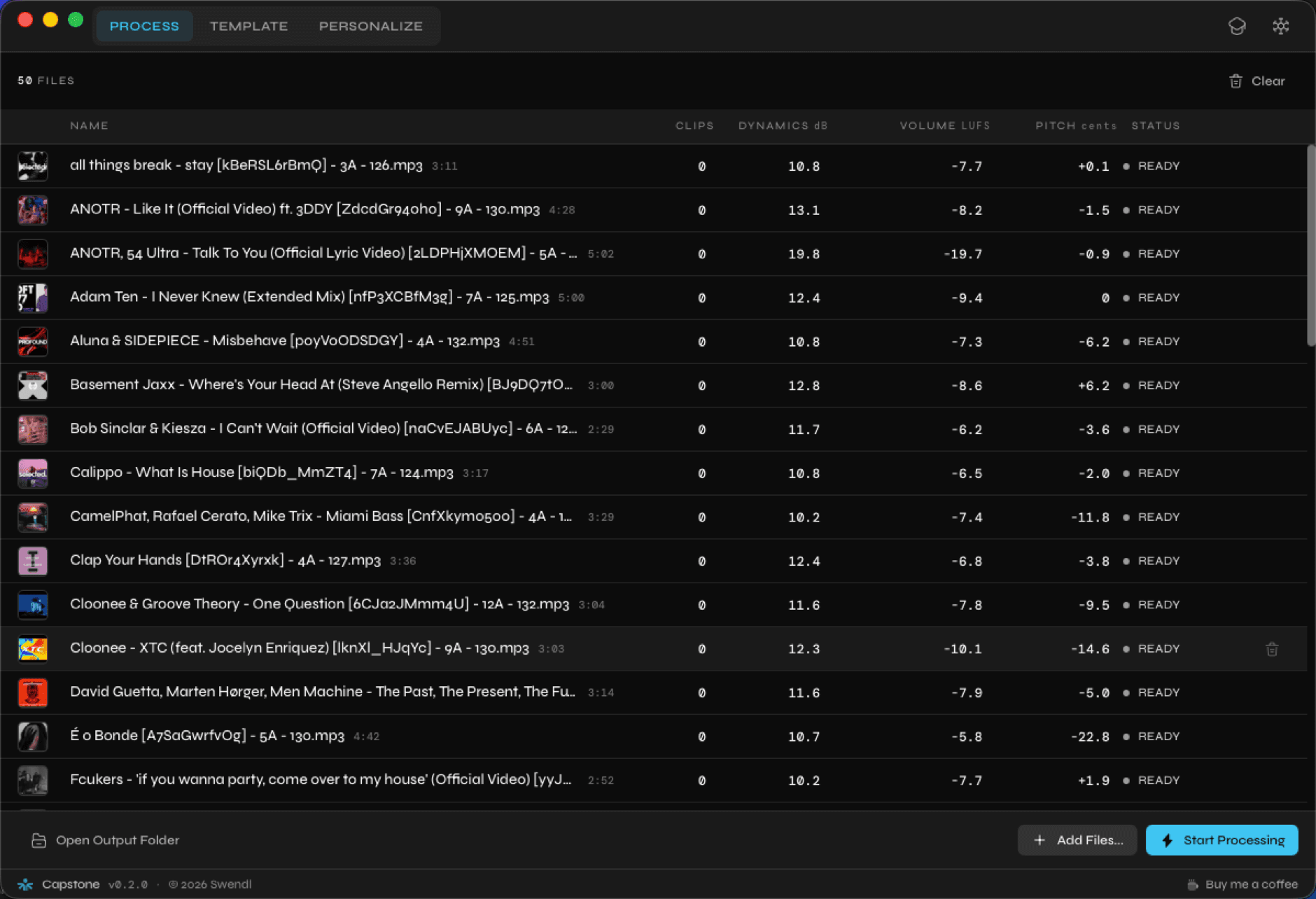
Point Capstone at your library. It levels every track, repairs the clipping and hands back files you can drop straight into a set.
Features
What it does to a library
Loudness
One level
Every track lands on the same LUFS target.
Clipping
Clip repair
Finds clipped samples and rebuilds the peaks.
Colour
Warmth
Optional analogue weight. Off by default.
Tuning
Pitch, in cents
Nudge a track into tune without a DAW.
Output
Copies only
Originals untouched. You pick the folder.
Local
Offline
No upload. No account. Your machine.
Before & after
One crate, one pass
Volume-18.1 … -8.6 LUFS→ -8.0 LUFS
Clips1 706 clipped→ 0 clipped
DynamicsUneven→ Held
Pitch3 tracks off→ In tune
What's New
Every update, in one place
v0.2.0Oct 31, 2026Latest
Cover art, right-click and shareable templates
The queue now looks like your library, every row has a menu, and a template is a file you can send to someone.
- Album art shows next to every file in the queue.
- Right-click a row to play it, reveal it, copy its path, re-analyze it or drop it.
- Export a template to a file and import one back. No account, no sign-in.
- A short tour on first launch, reopenable from the title bar.
- Dark and light themes rebuilt for readability: no more unreadable greys or dimmed-out fields.
- Version and a support link now sit along the bottom of the window.
v0.1.0Oct 31, 2026
First release
Drop in a folder of finished tracks and get them back at one consistent volume, with clipped peaks repaired and the tags still on them.
- Everything you process lands on the same loudness target, with a true-peak limiter so nothing distorts on the way there.
- Clipped peaks are repaired before anything else touches the file.
- Tracks sitting off concert pitch can be corrected, keeping the tempo or moving it with the pitch.
- Optional warmth and multiband dynamics, saved into named templates you reuse.
- Reads the formats a library is actually made of, writes AIFF, WAV, FLAC, ALAC or MP3, and carries your tags across.
- Your originals are never touched: processed files are written somewhere new.